

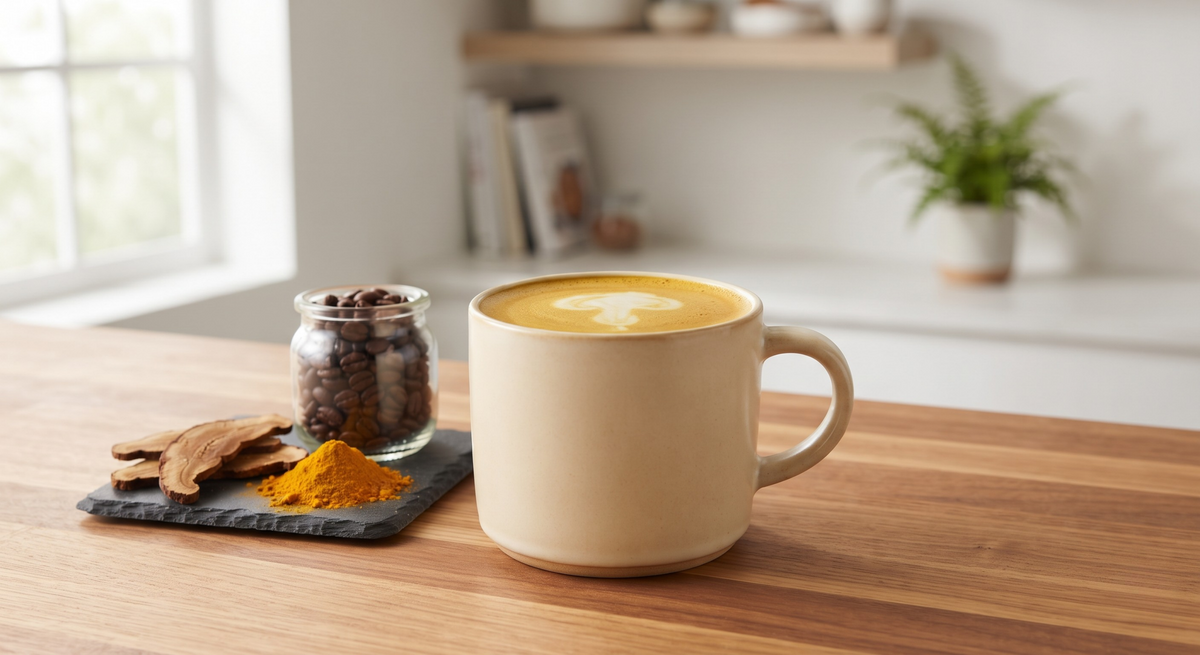
Turmeric latte, golden milk, curcumin latte, all these names are often used as if they mean the same drink. They do not.
Turmeric is a spice commonly used in cooking. Curcumin is one of its best-known bioactive compounds within curcuminoids, a family of naturally occurring bioactive compounds that researchers have studied for antioxidant activity, inflammation response, and joint comfort. A turmeric latte usually uses whole ground spice. A curcumin latte uses a concentrated turmeric extract.
Both can belong in a wellness routine. They simply answer different questions:
“Do I want a flavorful traditional latte?” versus
“Do I want a science backed functional latte with proven health benefits?”
Why a spoonful of turmeric is not the same as a curcumin extract
Whole turmeric brings aroma, color, and a broad plant matrix, but curcuminoids represent only a portion of the spice and the content can vary by growing region, processing conditions, and genetic makeup. Human trials usually do not test a casual kitchen sprinkle. They use a specified extract at a specific dose.
That does not make turmeric “bad” or an extract automatically “better.” It means the label should match your goal.
Choose culinary turmeric for flavor and food tradition. If you are shopping for a functional latte intended to support normal joint comfort or a healthy inflammation response, look for a standardized extract, and an intentional delivery format.
Absorption is a conversation most labels skip
Curcumin is poorly soluble in water and is rapidly metabolized. In an early human dose-escalation study, 24 healthy adults took single doses ranging from 500 to 12,000 mg of a standardized curcuminoid mixture. Free curcumin was difficult to detect in serum at most doses (Lao et al., 2006). This is one reason modern products use phospholipids, micelles, emulsions, piperine, or other delivery strategies to enhance curcumins absorption in the body.
A 2011 human crossover study compared a standardized curcuminoid mixture with a liposomal formulation containing lecithin. The liposomal version showed higher concentration of total curcuminoids in blood plasma (Cuomo et al., 2011).
Another randomized crossover study compared four curcumin formats in 12 healthy adults. All three formulated products increased total curcuminoid levels in the human subjects, compared to the unformulated curcumin format, but the absorption differed dramatically by technology (Jager et al., 2014).
What does the evidence say about joint comfort?
Several randomized trials have studied curcumin extracts in adults with knee discomfort. In one eight-week trial, 101 adults received 500 mg of a standardized curcumin extract twice daily or placebo. The extract group reported larger improvements on knee-pain measures, and some performance tests also improved (Lopresti et al., 2022).
A separate randomized trial used Curcumin C3 Complex® with piperine in adults with knee osteoarthritis and reported improvements in validated pain and function scores compared with placebo (Panahi et al., 2014). These studies involved different extracts and delivery systems, so their outcomes should not be treated as proof for every curcumin product.
Is black pepper the only way to improve curcumin absorption?
No. Piperine from black pepper is one studied strategy, but it is not the only one. Phospholipid complexes, lipid carriers, micelles, and other dispersible systems have also been studied. Each of them has a different absorption property and behave differently in food or beverage application.
For shoppers like you, the useful questions are more straightforward.
Does the label name the curcumin source? Does it disclose the amount? Does the company explain the delivery strategy without borrowing a dramatic absorption number from an unrelated formulation? Does the product fit the time of day you plan to use it?
Where Super Vitality fits
FIHI Super Vitality is not a traditional bedtime golden milk. It is a morning-oriented curcumin mushroom coffee. A serving includes 1000 mg liposomal curcumin complex made with Curcumin C3 Complex® and sunflower lecithin, 1000 mg organic lion's mane extract, and 1000 mg organic cordyceps extract, and organic Arabica coffee extract.
The strongest reason to choose Super Vitality over a basic turmeric latte is formula transparency. We use a science backed curcumin/turmeric extract for inflammation, a transparent curcumin-lecithin complex, and complementary bioactive ingredients like lion’s mane and cordyceps for focus and energy, respectively.
Enjoy it in the morning or early afternoon, especially if caffeine affects your sleep. Our vanilla extract and monk fruit soften the earthy ingredients, making the routine easier to repeat than swallowing several separate products.

The bottom line
A turmeric latte is a delicious food tradition. A curcumin latte is an intentional functional latte. If you want research backed standardized extracts, meaningful transparent dosage, optimal bioactive delivery, low -moderate caffeine, and clean ingredients then Super Vitality is the perfect choice for your morning ritual.
Super Vitality is an excellent option for someone who wants coffee, curcumin, lion's mane, and cordyceps in one focused morning ritual. It does not replace movement, recovery, sleep, or medical care. It makes an ordinary cup more intentional.
Quick Questions
Is curcumin the same as turmeric?
No. Turmeric is the whole plant-derived spice, curcumin is one of the major curcuminoids found within it.
Should I drink a curcumin coffee at night?
Use Super Vitality earlier in the day if caffeine disrupts your sleep
Primary References
Lao CD, Ruffin MT, Normolle D, et al. Dose escalation of a curcuminoid formulation. BMC Complementary and Alternative Medicine. 2006;6:10. https://doi.org/10.1186/1472-6882-6-10
Cuomo J, Appendino G, Dern AS, et al. Comparative absorption of a standardized curcuminoid mixture and its lecithin formulation. Journal of Natural Products. 2011;74(4):664-669. https://doi.org/10.1021/np1007262
Jager R, Lowery RP, Calvanese AV, Joy JM, Purpura M, Wilson JM. Comparative absorption of curcumin formulations. Nutrition Journal. 2014;13:11. https://doi.org/10.1186/1475-2891-13-11
Lopresti AL, Smith SJ, Jackson-Michel S, Fairchild T. An investigation into the effects of a curcumin extract on osteoarthritis pain of the knee: a randomized, double-blind, placebo-controlled study. Nutrients. 2022;14(1):41. https://doi.org/10.3390/nu14010041
Panahi Y, Rahimnia AR, Sharafi M, Alishiri G, Saburi A, Sahebkar A. Curcuminoid treatment for knee osteoarthritis: a randomized double-blind placebo-controlled trial. Phytotherapy Research. 2014;28(11):1625-1631. https://doi.org/10.1002/ptr.5174
Share:
Saffron Latte Benefits: What Human Studies Say About Mood, Stress and Daily Use
Meet Your New 5-Minute Pink Smoothie: Strawberry Vanilla Protein Shake