

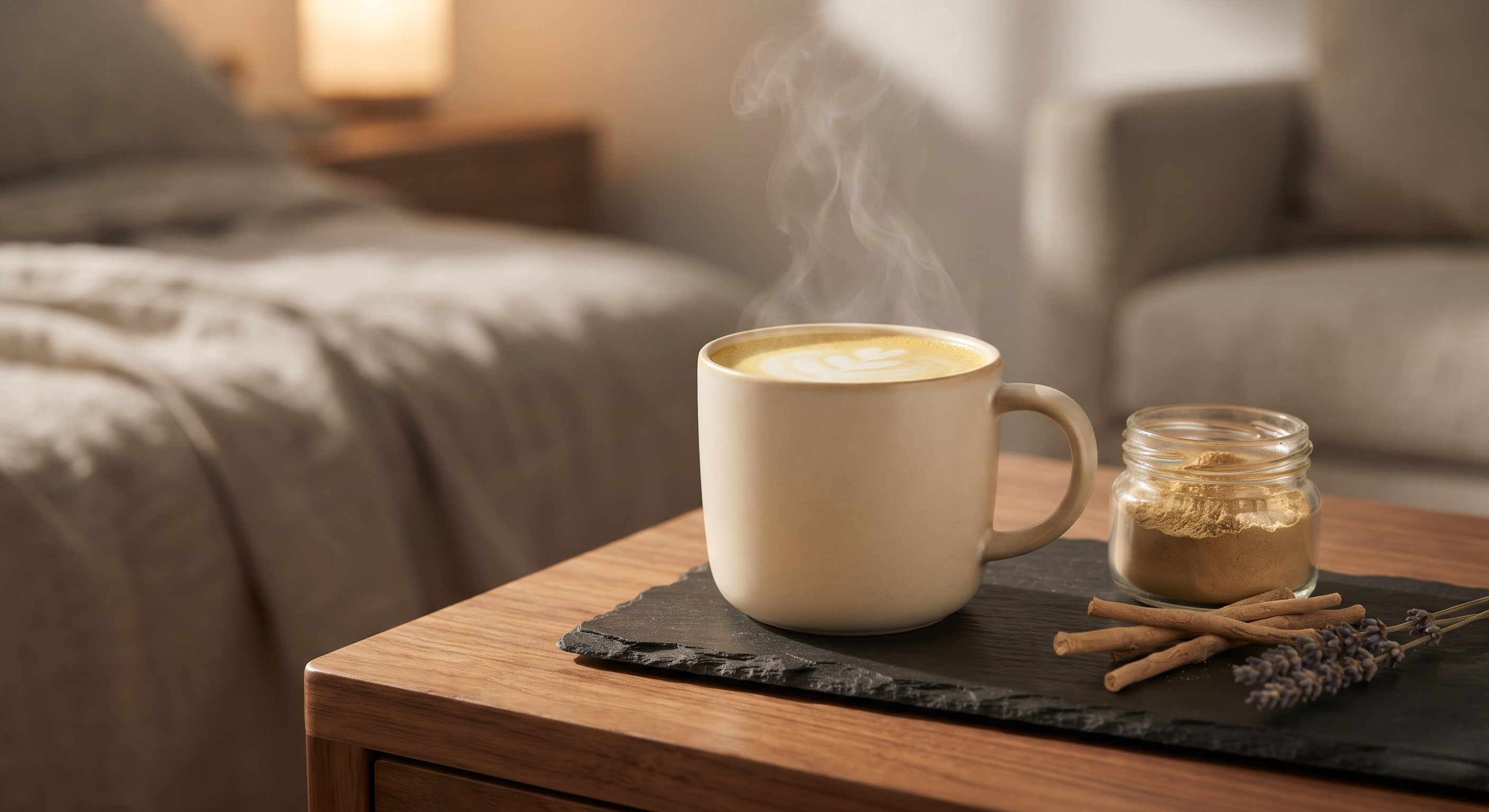
Is your body exhausted, while your mind keeps hosting one last meeting?
That gap between “I should wind down” and actually feeling ready to relax is exactly why ashwagandha lattes have become popular.
An ashwagandha latte or moon milk is usually a warm, caffeine-free drink made with milk or a plant-based alternative, ashwagandha, and comforting flavors such as vanilla, coconut, or cinnamon. Its most realistic role is not to knock you out like a sedative. It is to make a calmer, repeatable evening ritual while providing a studied botanical that may support the body's response to occasional stress and aspects of sleep quality.
What is ashwagandha, and why is it called an adaptogen?
Ashwagandha, or Withania somnifera, is a botanical used in Ayurveda. It is commonly described as an adaptogen, an ingredient intended to support resilience to physical or psychological stressors. Its root contains naturally occurring compounds called withanolides. Plant extracts can differ widely in plant part used, concentration, and manufacturing process.
That variation matters. A spoonful of generic root powder is not automatically equivalent to a standardized root extract used in a clinical trial. When you compare ashwagandha latte powders, look for the plant part, extract name or standardization, and amount per serving.
What does the research say about ashwagandha’s stress relief benefits?
One frequently cited randomized, double-blind trial enrolled 64 adults experiencing ongoing stress. Participants received either placebo or 300 mg of KSM-66®, a high-concentration ashwagandha root extract, twice daily for 60 days. The ashwagandha group reported significant improvements on multiple stress-assessment scales, and the researchers measured a greater change in serum cortisol (stress hormone) compared to the placebo group (Chandrasekhar et al., 2012).
Other randomized trials using different ashwagandha extracts have also reported improvements in perceived stress, but doses, extract composition, populations, and outcomes vary.
That is why a “clinically studied ingredient” is more informative when the product also tells you which ingredient and how much is used in the formula.
Can an ashwagandha latte support sleep quality?
The sleep evidence is encouraging for those who are interested in trying ashwagandha. In a ten-week randomized trial, adults with sleep difficulty took 300 mg of KSM-66 twice daily or placebo. The extract group showed improvements in measures including sleep onset latency, sleep efficiency, and self-reported sleep quality (Langade et al., 2019).
A later eight-week trial included both healthy adults and adults with insomnia. Participants again received 300 mg of KSM-66 twice daily or placebo. Sleep improvements were clearer among participants who began with insomnia, although healthy participants also reported some benefit (Langade et al., 2021). Across the broader evidence, effects tend to be modest, however most studies are generally short.
Ashwagandha is better as a consistency ingredient to improve overall wellbeing, than an instant sleep switch. Pairing it with dimmer lights, a regular bedtime, less late caffeine, and a warm drink give the ritual a fair chance to work.
When is the best time to drink an ashwagandha latte?
There is no single research-proven clock time for everyone. If the blend is caffeine-free and your goal is a wind-down routine, try it 60 minutes before your usual bedtime or along with your dinner.
If ashwagandha makes you feel alert rather than relaxed, move it earlier in the day. If it causes stomach discomfort, taking it with food may help. Ayurveda recommends taking ashwagandha with warm milk (referred to as anupana or a carrier substance) that helps enhance the herb's absorption, grounding qualities, and tissue-nourishing benefits
Consistency matters more when it comes to herbal formulations. The relevant trials typically lasted six to ten weeks. Keep expectations gradual, follow the product directions on the back panel, and pay attention to how you feel.
What should you look for on the label?
First, look for a root extract rather than an unexplained “ashwagandha blend.”
Second, compare the full daily serving with the amount studied.
Third, check whether the drink contains caffeine or substantial added sugar, two details that can work against an evening routine.
Finally, choose a flavor you will actually enjoy several times a week.
FIHI Super Relax is designed around those questions. A full serving provides 600 mg of KSM-66® ashwagandha root extract, matching the daily amount used in the trials described in literature. It is caffeine-free and combines the extract with 1,000 mg of organic reishi, coconut milk powder, vanilla, and monk fruit. Our formula turns a capsule habit into a creamy vanilla-coconut ritual without hiding the main ashwagandha amount.
Who should check with a healthcare professional first?
Ashwagandha is not appropriate for everyone.
The National Institutes of Health notes that short-term use is often well tolerated, while long-term safety is not established. Mild digestive effects and drowsiness can occur, and uncommon liver-injury reports have been published. Ashwagandha can affect thyroid function and may interact with thyroid medicine, sedatives, immunosuppressants, blood-pressure medicine, and blood-sugar medicine.
People who are pregnant or breastfeeding, have a liver or thyroid condition, or take regular medication should speak with a qualified clinician before using any type of ashwagandha infused products.

The bottom line
The best ashwagandha latte may be the combination of evidence and behavior, a clearly dosed extract inside a ritual that tells your evening to change gears.
If you want a caffeine-free option with 600 mg of KSM-66® ashwagandha and a creamy coconut-vanilla taste, Super Relax is the perfect place to start. Use the product consistently to feel the benefits, and let your sleep routine do part of the work.
Quick Questions
Will an ashwagandha latte make me sleepy immediately?
Not necessarily. Ashwagandha is not a sedative. Human trials generally evaluated consistent use over several weeks.
Can I drink it every night?
Follow the label and discuss regular use with a clinician if you have a medical condition or take medication. Human safety evidence is strongest for short-term use, generally up to about three months.
Primary References
Chandrasekhar K, Kapoor J, Anishetty S. A prospective, randomized double-blind, placebo-controlled study of safety and efficacy of a high-concentration full-spectrum extract of ashwagandha root in reducing stress and anxiety in adults. Indian Journal of Psychological Medicine. 2012;34(3):255-262. https://doi.org/10.4103/0253-7176.106022
Langade D, Kanchi S, Salve J, Debnath K, Ambegaokar D. Efficacy and safety of ashwagandha root extract in insomnia and anxiety: a double-blind, randomized, placebo-controlled study. Cureus. 2019;11(9):e5797. https://doi.org/10.7759/cureus.5797
Langade D, Thakare V, Kanchi S, Kelgane S. Clinical evaluation of the pharmacological impact of ashwagandha root extract on sleep in healthy volunteers and insomnia patients: a double-blind, randomized, parallel-group, placebo-controlled study. Journal of Ethnopharmacology. 2021;264:113276. https://doi.org/10.1016/j.jep.2020.113276
Verma N, Gupta SK, Tiwari S, Mishra AK. Safety of ashwagandha root extract: a randomized, placebo-controlled, study in healthy volunteers. Complementary Therapies in Medicine. 2021;57:102642. https://doi.org/10.1016/j.ctim.2020.102642
National Institutes of Health, Office of Dietary Supplements. Ashwagandha: Fact Sheet for Health Professionals. Updated May 2, 2025. https://ods.od.nih.gov/factsheets/Ashwagandha-HealthProfessional/
Share:
What Is a Functional Latte? A Science-Backed Guide to Adaptogenic Lattes and Superfood Lattes
Saffron Latte Benefits: What Human Studies Say About Mood, Stress and Daily Use